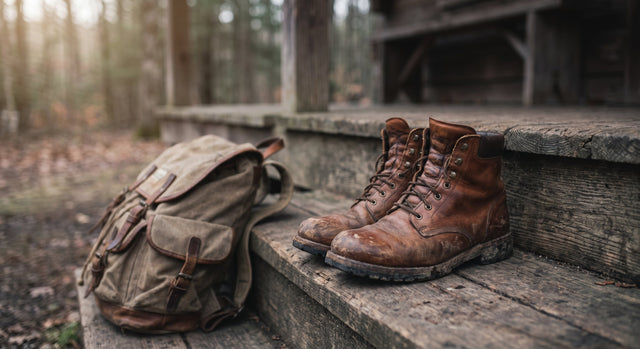
How do you look after leather boots?
Brush the dirt off after wear, clean them when they are actually dirty, and condition the leather in a thin coat once a month for work boots or every few months for dress boots. Dry wet boots slowly, away from heat. That is most of what keeps a pair going for years.
Why boots fail
Boots rarely wear out through the leather. They fail because the leather at the flex point across the toe dries, stiffens and cracks, and once the upper splits the boot is finished regardless of how much sole is left. Conditioning keeps that flex point supple, which is why a monthly habit is worth more than an occasional big effort.
The method
- Brush first. A horsehair brush takes the dust and dried mud off without scratching. Do this after every decent wear.
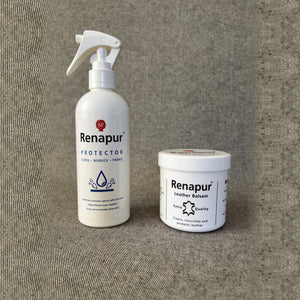
- Clean when needed. If they are genuinely dirty, use Renapur Leather Cleaner Spray on a cloth, then let the boots dry.
- Condition. A small amount of Renapur Leather Balsam on a sponge, worked over the whole upper including the tongue and the welt. Thin coat. If you can see it on the sponge, it is too much.
- Leave them. No buffing needed. Give them a few hours before wearing.
How often?
Work boots that get wet, dusty or muddy want conditioning monthly. Dress boots worn to the office are fine every two or three months. Boots stored over summer should be conditioned before they go away, not after, because they dry out fastest sitting still in a hot cupboard.
Drying wet boots
Take the insoles out, stuff the boots loosely with newspaper, and leave them somewhere with moving air but no direct heat. Never put leather boots in front of a heater, a fire or in the sun. Heat drives the remaining oils out of hide that is already stressed, and that is what turns a soaked boot into a cracked one. Once they are dry, condition them, because the water took oils with it on the way out.
Does conditioning waterproof boots?
It helps. Renapur contains beeswax and carnauba wax, and a conditioned boot sheds water rather than soaking it up, which you can see as beading on the toe. It is not a membrane and it will not make a boot waterproof in the way a sealed liner does, so treat it as good water resistance rather than a guarantee.
Suede, nubuck and rough out boots
Do not put balsam on them. It flattens the nap and the result is not easily undone. Suede, nubuck and fabric want the Protector Spray. Plenty of boots mix both, a smooth leather upper with a nubuck panel, and in that case treat each material with the right product and keep them apart.
What about the sole and the stitching?
Conditioning the welt area is worthwhile because the stitching sits in leather that flexes constantly. Keep the balsam off rubber soles, not because it harms them but because it does nothing for them.
One jar or two?
For boots alone a 50ml jar lasts a long time, since a pair of boots takes very little. If you are also looking after a lounge, a car interior or saddlery, the 200ml is the sensible size. The Boot and Outdoor Kit pairs the balsam with the protector so both materials on a boot are covered.
Not sure what you have? The Care Finder asks three questions and tells you which product to use, including when the answer is not the balsam.